
Saad Mohammad Abrar
Introduction
Hi, I am Saad! I am a postdoctoral scholar at UC Santa Barbara in the Urban Data Research Lab, directed by Dr. Wenfei Xu. I completed my Ph.D. in Computer Science at the University of Maryland, College Park, advised by Dr. Vanessa Frias-Martinez in the Urban Computing Lab.
My research is in general is situated in computational social science, drawing methodologies from machine learning, statistics, and fairness methods. I aim to improve high-stakes decision-making by leveraging behavioral data to build accurate and trustworthy predictive systems.
My dissertation, Data-Driven Decision-Making for Societal Systems: Auditing Mobility, Contextual Data and Models for High-Stakes Applications, develops frameworks to audit mobility and contextual data—and the predictive models built on them—along the dimensions of utility, fairness, and validity before they are trusted in high-stakes settings such as public health and economic policy. Through my research, I aim to ensure that data-driven urban computing applications serve all communities equitably while maintaining high predictive performance. My research has led to 17 peer-reviewed publications (10 journal articles, 3 conference papers, 4 workshop papers) in venues such as PLOS One, EMNLP, International Journal of Social Research Methodology, ACM SIGSPATIAL, Computers Environment and Urban Systems, ACM JCSS, EPJ Data Science, Big Data & Society, and Behavior Research Methods.
I completed my M.S. in Computer Science from UMD (2023) and my BSc in Computer Science and Engineering from Bangladesh University of Engineering and Technology (BUET) in 2017.
| Dissertation | Research Statement | Teaching Statement | Academic CV |
Recent News
- September 2026 I have joined UC Santa Barbara as a postdoctoral scholar in the Urban Data Research Lab.
- September 2026 Paper "The Coordinates Were Always There: Detecting and Quantifying Pretraining Contamination from Geospatial Data in LLMs" accepted at ACM SIGSPATIAL '26.
- September 2026 New preprint "Do LLMs Know Your Neighborhood? Auditing LLM Priors for Neighborhood-Level Mobility Prediction and Structural Alignment" is now on arXiv.
- July 2026 My PhD dissertation, Data-Driven Decision-Making for Societal Systems: Auditing Mobility, Contextual Data and Models for High-Stakes Applications, is now available on DRUM.
- May 2026 New journal article "The benefits of in situ reporting" published in Behavior Research Methods.
- April 2026 New journal article "Assessing the impact of case correction methods on the fairness of COVID-19 predictive models" published in EPJ Data Science.
- March 2026 New journal article "From 'I have nothing to hide' to 'Its stalking'" published in Big Data & Society.
- February 2026 New journal article "Fairness Correction in COVID-19 Predictive Models Using Demographic Optimization" published in Online Journal of Public Health Informatics.
- November 2025 Our paper ProcVQA is live at EMNLP '25. Paper | Code
- November 2025 Traveling to Minneapolis, MN for ACM SIGSPATIAL '25.
- September 2025 Two papers accepted: "Engaging underserved communities in smartphone-based research" at International Journal of Social Research Methodology, and "Beyond Mode Detection: Reconstructing Transit Itineraries" at the ACM SIGSPATIAL 2025 Workshop.
- August 2025 Paper "ProcVQA: Benchmarking Vision-Language Models" accepted at EMNLP Findings '25. Code available via the link.
- February 2025 Paper on Auditing fairness of US COVID-19 Forecast Hub models accepted at PLOS One.
- October 2024 Presented our work on disparate recovery trajectories of small business restaurants across the USA at NetMob 2024.
Research Focus
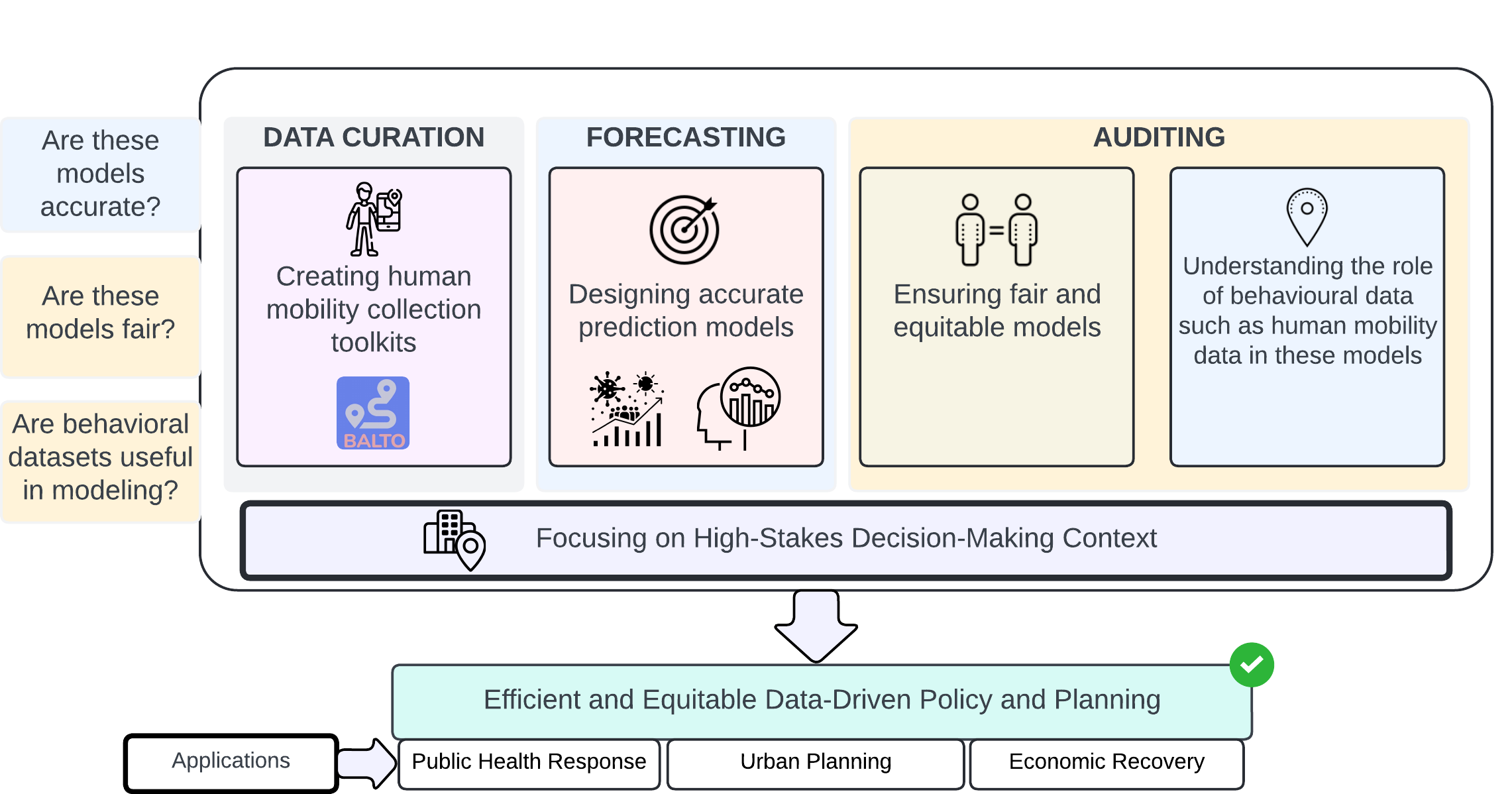
Model: I design accurate predictors that leverage contextual and behavioral signals to improve forecasting in high-stakes settings. Through systematic evaluation, I determine when and how mobility and social media data enhance predictions across public health, crime, and related domains. [EPJ Data Science ‘22, JCSS ‘23, JMIR ‘23]
Mitigate: I develop comprehensive audit frameworks that uncover bias and failure modes in both data and models. By separating data-driven from model-driven failures, I create targeted fairness strategies that address disparities across demographics and geographies in predictive systems. [CEUS ‘23, JCSS ‘23, PLoS One ‘25, EMNLP Findings ‘25]
Measure: I build ethically-aware data collection toolkits that empower communities to gather and analyze their own mobility and experiential data. Through participatory design that prioritizes consent and transparency, I enable equitable decision-making in public transit planning. [COMPASS ‘23, IJSRM ‘25]
This research aims to enable efficient and equitable data-driven policy and planning, with direct applications in:
- Public Health Response
- Urban Planning
- Economic Recovery
- Transportation Equity